
The Budget Dilemma
Every leader I talk to right now is saying the same thing: budgets are shrinking. The loss of federal funding that used to be dependable and the rising cost of nearly everything, from supplies to training tools, software to salaries, has forced organizations to face difficult choices about what to shift and it can be difficult to prioritize team development. I hear versions of this same struggle from many of the teams and leaders I connect with. Some teams are bound by new policies made by their organizations to limit or restrict spending, while other teams aren’t stuck on policy, they’re stuck on dollars. The budget for real team development is so small that leaders end up piecing together something internally instead of utilizing external experts. I have heard teams decide to do a potluck, a half day cobbled together in house, or a classic team bonding day, when what was actually needed was real investment in the team. Conversely, a select few leaders are choosing something different, and the interesting thing isn’t what they’re sacrificing; it’s what they’re choosing to protect.
Why Smart Leaders Protect Development
When I asked Elyse Lohrbach, our Executive Director, how she’s making decisions right now, while budgets are tight, she didn’t talk about financial exercises and mission alignment frameworks. While those things are an important part of a larger strategy, she talked about the necessity of a strong, intact team. “Team development is a form of risk management for organizations” she said. “A strong team can adapt, prioritize, and solve problems together. If we are disconnected, we are burning time and energy to manage confusion and frustration, rather than problem-solving things like a tight budget.” We asked our Advancement Director, Stephanie Vorhees, why she believes team development still matters right now. She said, “One thing I’ve learned is that team development is a lot like when we’re keeping any other healthy habits. You don’t build strength with one workout, and you don’t build a strong team with one retreat. The investment is in the consistency, and it’s that consistency that carries teams through uncertain times.”
With the cost of almost everything rising, it would be easy to look at your budget and decide that team development is optional. It’s easy to see it as something that only touches morale, not the mission, and pause it without much thought. Typically, when leaders are faced with this decision, most teams choose to cut team and professional development from the budget. What we are seeing at Camp Joy, however, is a growing group of leaders choosing a different way. These leaders are realizing something different: some pieces of a team’s success can’t be measured on a spreadsheet. They have an instinct to protect what isn’t showing up in the numbers, and that instinct is exactly what the data backs up.
What the Research Says
Gallup’s State of the Global Workplace found that only 20% of employees worldwide were engaged at work in 2025. They estimate this slide cost the global economy $10 trillion in lost productivity (Gallup, 2026). This isn’t a hiring or talent problem. It’s a lack of investment in team and leadership development as an organization. As soon as the decision is made to pause professional and team development, that percentage moves in the wrong direction.
When we look at the upside of organizations investing in team development we see that orgs with highly engaged teams see 21% greater profitability and stronger customer outcomes, according to Gallup’s long-running Q12 research. Teams in the top quartile for engagement also outperform bottom-quartile teams by 23% in profitability and 43% in retention (Gallup, 2021). Retention alone should grab a leader’s attention. Passionate staff is a company’s greatest resource, it is always better, and less expensive, to keep them engaged than to lose them, recruit, hire and train new staff. Professional and team development isn’t just for the employee, it’s a retention strategy.
The Center for Creative Leadership’s 2026 research on L&D budgets shows that leadership development is actually a strategic investment. “Underinvestment weakens competitive standing, slows agility, and depletes the leadership pipeline (CCL, 2026).” When development budgets tighten, organizations don’t just save money in the short term. They quietly weaken their competitive standing, and thin out their leadership pipeline right when they need it most. Protecting development on any scale is what lets an organization navigate today’s challenges without losing tomorrow’s competitive advantage.
What I have learned is that funding gaps and rising costs are real, and hard calls are still going to be hard calls. But the data is consistent: team building, culture, and development aren’t the safe place to cut. In uncertain conditions, they’re often the reason a team can absorb a hard year at all.
Why Relationships Matter
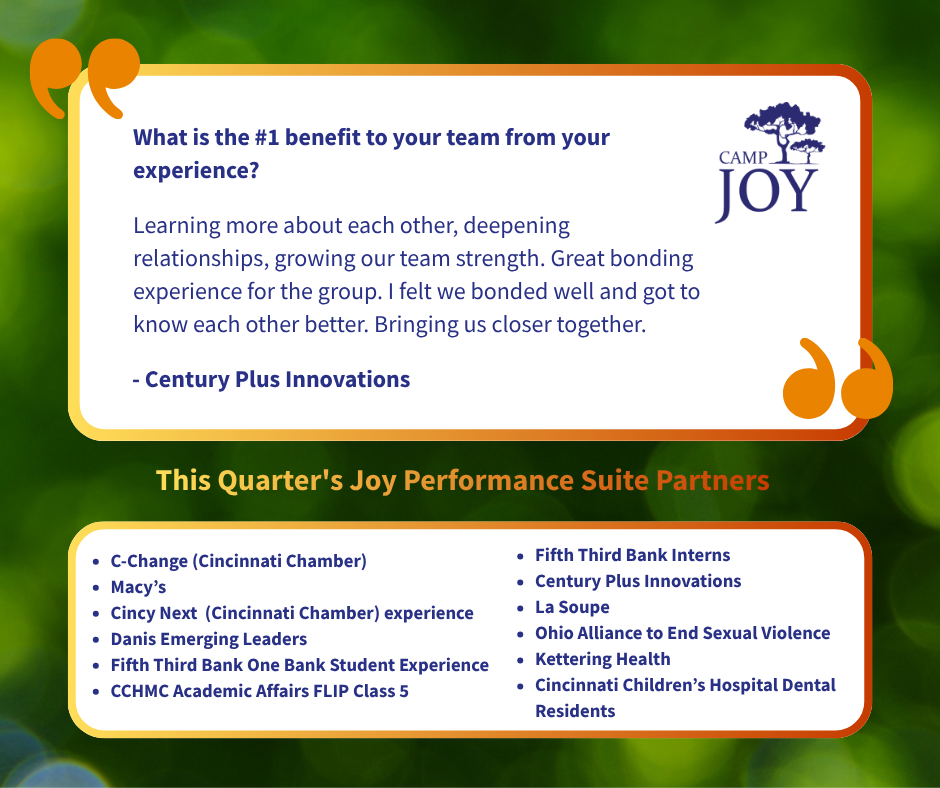
I was recently asked, “in a fast-paced world where we rely heavily on technology, how does Camp Joy stay relevant?” I immediately answered that it comes down to relationship building. Building strong, trusting relationships is essential to how a team functions. There is no better place to fast-track a team’s relationship development than through Camp Joy’s Joy Performance Suite. Our clients are faced with real challenges and guided through hard conversations together, and that combination catapults their relationships with each other. They leave feeling realigned, reenergized, and reengaged. Coworkers who once just worked alongside each other build trust, and their working relationships and organizations greatly benefit.
Leading Through Uncertain Times
Elyse captures the magic of team development when she reflects on her first year at Camp Joy. “The success I’m most proud of is creating a more inclusive approach to decision-making. From board members to front-line staff, I’ve worked to ensure a wide range of voices helps shape our direction because diverse input leads to stronger, more innovative ideas.” At Camp Joy we believe that dedicating ourselves to developing our team culture has allowed us to adapt to an ever changing world while staying consistent in our quality of programming (for almost 90 years!)
Elyse’s successes reflect the conclusions that Gallup, LinkedIn, and CCL are all pointing to: the teams who make it through uncertain seasons intact, are the ones led by someone willing to prioritize team development even in the face of shrinking budgets. The leaders who are investing in their teams’ relational, professional and team development, even in small ways, aren’t just being sentimental, they are reading the numbers correctly.
Our newsletter is growing and it would bring us Joy if you would subscribe and follow along on LinkedIn.